
Ariadne's Thread
Exploration, imagination, and the power of doubt

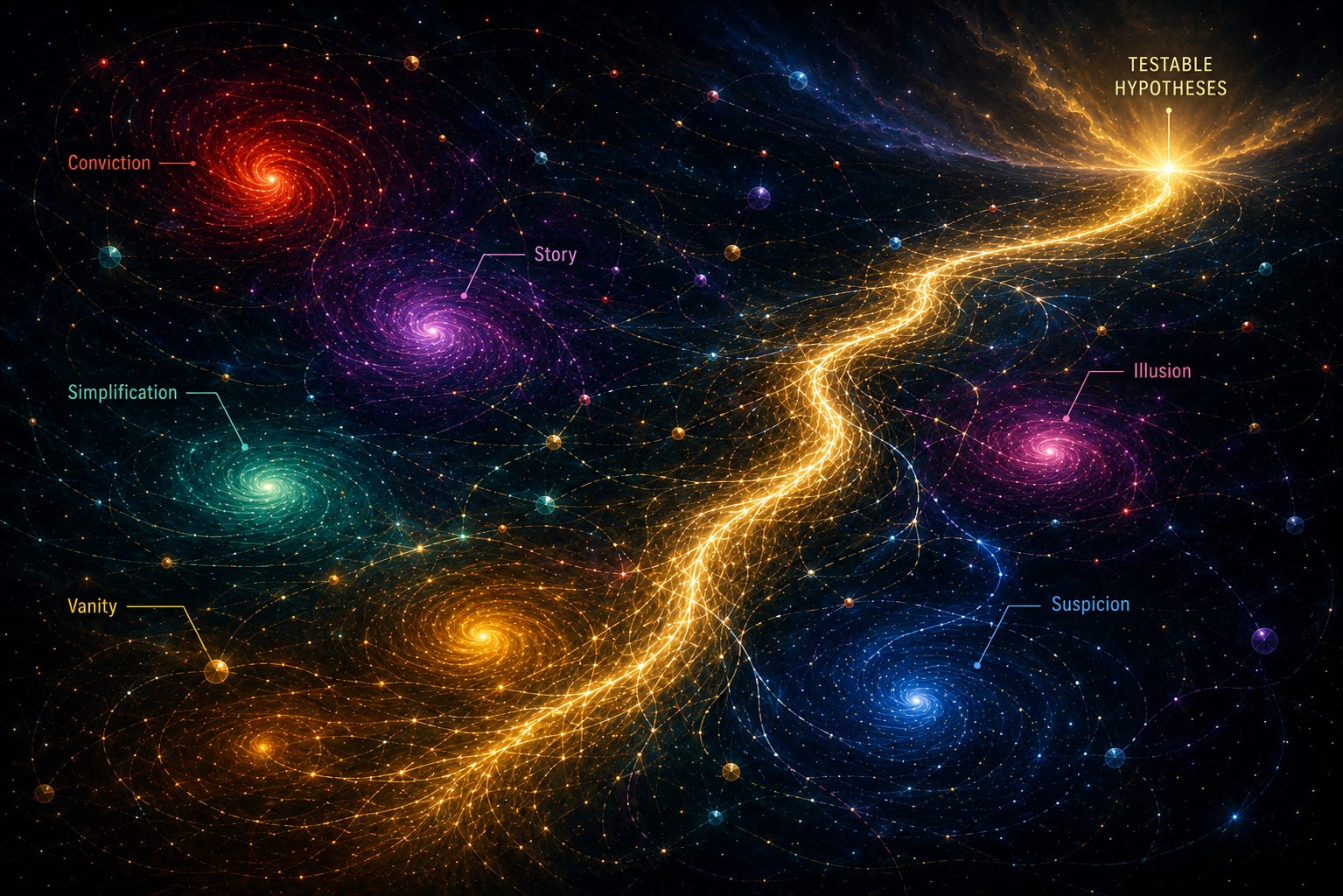
The ancient Greeks believed that Ariadne's thread allowed Theseus to explore the Labyrinth without becoming trapped. I have begun to wonder whether doubt serves a similar purpose in our journeys through ideas. Most ideas disappear almost as quickly as they arrive. Thousands pass through our minds every day without changing anything. They solve a small problem, remind us to buy some milk, trigger a memory, or simply vanish before we notice them. They leave little trace.
But occasionally an idea behaves differently. A coincidence nags at us. A conversation keeps replaying in our minds. An unexpected connection appears between two things we had never thought to relate before. We return to the thought the next day, and then again the day after that. Gradually, almost without noticing, it begins to influence what we pay attention to. New experiences seem to connect with it. Different conversations begin to revolve around it. Somewhere along the way something subtle has happened. We are no longer simply thinking about the idea. The idea has begun to organise our thinking.
That moment fascinates me. In my previous essay, The Conversations That Change Us, I suggested that conversations leave traces. Unlike memories, which record what has happened, traces alter what is likely to happen next. Every conversation changes, however slightly, the landscape through which the next conversation will travel. Most of the time those changes are helpful. They allow us to learn, to revise our beliefs, to understand one another a little better.
But not every conversational path leads towards understanding. Some lead somewhere stranger. An innocent suspicion gradually becomes a conviction. An interesting possibility becomes the explanation for everything. A disagreement hardens into a grudge. Each step seems reasonable when viewed on its own. Yet taken together they reveal a trajectory that has quietly begun to narrow. Alternative explanations become harder to see. The conversation acquires momentum of its own.
Ideas do not simply accumulate. They reshape the landscape through which later ideas must travel. That observation raises a question that extends far beyond artificial intelligence.
What allows exploration to remain connected to reality?
It is a question that matters because imagination is one of humanity’s greatest strengths. Every scientific revolution, every philosophical breakthrough, every artistic innovation begins by venturing beyond what is already known. If we never left familiar ground, there would be little left to discover.
Yet exploration carries its own risks. The very capacities that allow us to imagine new possibilities can also lead us away from the shared world against which those possibilities must eventually be tested. The same mental machinery that sometimes produces paranoia, conspiracy theories, and delusions also contributes to science, religion, creativity, and discovery. The difference is not imagination itself. The difference lies in whether we retain a route back.
Conversations as Landscapes
Researchers studying extended conversations with AI have recently begun describing dialogues in terms of trajectories, attractors, basins, drift and re-entry. These terms come from dynamical systems theory, but they capture something that most of us recognise intuitively.
A conversation is not simply a sequence of isolated questions and answers. It moves. Every exchange changes the context of the next. Possibilities open. Others quietly close. Some pathways encourage curiosity and correction. Others gradually become self-reinforcing.
Seen in this way, conversations begin to resemble journeys across a semantic landscape. The important question is not whether such landscapes exist. We experience them every day. The more interesting question is why some journeys continue to explore while others gradually become trapped. Long before large language models existed, psychology had already begun studying remarkably similar phenomena.
What Psychology Already Knows
The idea that conversations can drift is familiar. The idea that we can study, measure and perhaps even predict that drift is much newer. Long before anyone imagined holding extended conversations with artificial intelligence, psychologists were studying the ways in which human reasoning sometimes becomes increasingly self-reinforcing. They observed that certain patterns of thought seem to acquire a momentum of their own. A passing suspicion grows into a conviction. An attractive possibility becomes the explanation for everything. The original idea is no longer simply one interpretation among many. It has become the lens through which every subsequent experience is viewed.
Long before current interest in AI conversations, I approached this question from a rather different direction. I developed the Rust Inventory of Schizotypal Cognitions (RISC) to investigate unusual patterns of human thought, perception, attribution and self-reflection. At the time, I regarded it simply as a psychometric instrument. Looking back now, however, I find myself wondering whether it may also have been measuring something more general. Perhaps the underlying dimensions are not simply characteristics of people. Perhaps they are also characteristics of journeys through semantic space. It suggests a rather broader interpretation of the instrument. A fuller description of the RISC and the dimensions it measures is on my website.
The individual RISC items do not merely describe unusual beliefs. They repeatedly probe the boundaries that normally keep our understanding of the world stable. Boundaries between imagination and perception. Between coincidence and intention. Between our own thoughts and those of other people. Between possibilities and established facts. Between what is directly experienced and what is inferred.
When those boundaries remain flexible, they allow us to explore unfamiliar ideas while still retaining contact with evidence and with other people. When they begin to weaken, something rather different can happen. New experiences are no longer used to test an emerging interpretation. Instead, they are increasingly recruited to support it. The resulting trajectory may feel coherent, illuminating, even exhilarating. From within, it often seems that the world is finally beginning to make sense. Yet this is precisely the point at which exploration may quietly begin to lose one of its most valuable qualities. Its ability to return. Three familiar examples illustrate what I mean.
Three Familiar Journeys
These examples are deliberately ordinary. Most of us have travelled at least part of each of these paths. They become dangerous not because they begin in unusual places, but because they gradually lose their connection with alternative explanations.
The Watchers
Imagine that you mention an obscure book to a colleague in a phone call, text message or email. Later that evening an advertisement for exactly that book appears on your phone. A few days afterwards someone unexpectedly brings the same subject into conversation. It feels... curious. Most of us shrug and move on. We know that in a world saturated with algorithms and coincidence, strange conjunctions are bound to occur.
But suppose the pattern continues. The coincidences begin to accumulate. They seem just a little too precise, a little too frequent. For some, a passing curiosity becomes a suspicion. Perhaps someone—or perhaps an AI—is listening in on your phone calls. At first this remains only one possibility among many. The difficulty begins when each new coincidence is interpreted as further confirmation. Reassurance no longer reassures because it, too, can be explained away. Friends become part of the story. Silence becomes suspicious. Coincidences become clues.
The journey did not begin with irrationality.
It began with an entirely reasonable question.
The Inner Light
Now imagine a different experience. A scientific idea suddenly seems capable of explaining several unrelated observations. A passage in a book feels uncannily relevant to a question that has occupied you for months. An ordinary object, a melody, or even a shaft of sunlight appears charged with unexpected significance.
Such moments are among the pleasures of being human. Occasionally they are the beginning of genuine discovery. Scientists often describe the exhilaration of seeing a pattern that nobody else has recognised. Artists speak of moments when a work seems almost to reveal itself. Philosophers sometimes find that a single idea suddenly reorganises an entire landscape of thought. The feeling itself is not the problem.
The difficulty arises when the emotional force of the experience begins to substitute for the evidence that must eventually support it. Every new observation appears to fit. Every coincidence seems meaningful. Every disagreement becomes further proof that others have simply failed to see what now appears obvious. The light that first illuminated the path gradually becomes the only light by which the traveller is willing to see.
The Hidden Door
There is one further journey that has fascinated storytellers for centuries. What if reality itself is not quite what it appears? Perhaps we are living in a simulation. Perhaps consciousness is dreaming the world. Perhaps there is a deeper order concealed beneath ordinary experience. Films such as The Matrix continue to resonate because almost everyone has entertained thoughts like these, if only for a few moments.
For most of us the thought remains an interesting possibility. For others it becomes increasingly compelling. The hidden reality begins to feel more substantial than the shared one. Every ambiguity seems to point towards it. Every unanswered question becomes evidence that something larger is waiting to be uncovered.
Yet history reminds us that this path has led in very different directions. It has inspired scientific revolutions, philosophical breakthroughs and religious renewal. It has also led to delusions, conspiracy theories and beliefs that become impossible to test because every apparent contradiction is absorbed into the theory itself. The crucial difference is not whether we are willing to imagine another reality. It is whether we remain willing to return.
A Different Question
At first sight these three journeys may seem to have very little to do with artificial intelligence. Language models do not suffer from paranoia. They do not experience religious revelation. They do not become clinically deluded. If we think of these examples simply as psychiatric diagnoses, the comparison quickly reaches its limits. But those diagnoses are not what interests me here. What interests me are the underlying patterns through which meaning gradually becomes organised.
But perhaps we are making the wrong comparison. Perhaps the important question is not whether AI systems can think like people. Perhaps it is whether human-AI conversations can sometimes develop trajectories that resemble familiar patterns of human reasoning. That is a rather different way of looking at the problem.
Every extended conversation develops a history. Each exchange changes the context in which the next exchange is interpreted. Certain possibilities become more likely, while others quietly fade from view. The conversation acquires direction. It develops momentum. Neither the human nor the AI determines that trajectory alone. It emerges from their interaction.
Seen in this way, the conversation itself becomes the object of study. The question is no longer whether either participant is “right” or “wrong”. Instead, we can ask whether the trajectory remains open to correction. Does it continue to generate alternative interpretations? Does it remain willing to test its own conclusions against new evidence? Or has it begun, almost imperceptibly, to organise every new observation around a single emerging narrative? These are not questions about minds alone. They are questions about conversations.
Looking back at the RISC after many years, I find myself wondering whether I may have underestimated what it was measuring. I originally developed it to investigate individual differences in unusual patterns of thought. Yet the dimensions themselves describe something more general. They describe different ways in which meaning can become organised, and sometimes reorganised, as one interpretation gradually comes to dominate the others.
That possibility seems newly relevant in the age of AI. If conversations really do follow trajectories through semantic space, then perhaps the dimensions explored by the RISC are not simply characteristics of people. Perhaps they also describe recurring patterns through which conversations themselves may drift. I do not know whether this hypothesis will prove to be correct. But it is a hypothesis that can be tested. And that is where the story becomes particularly interesting.
From Description to Measurement
If this way of thinking is correct, then it leads to a practical question. Can conversational trajectories be measured? The value of the RISC framework is not that it provides ready-made answers. It does not. Nor am I suggesting that conversations with AI should be understood through the lens of psychiatry. They should not. Its value lies elsewhere. It suggests that different forms of conversational drift may leave recognisable signatures.
Some trajectories may show an increasing tendency to attribute hidden motives or unseen agency. Others may gradually lose track of where ideas originated, confusing suggestions made by the user, the AI, or external sources. Others may begin treating possibilities as established facts, or vivid simulations as evidence in their own right. Still others may become progressively less responsive to contradictory information, quietly reorganising every new observation around an emerging narrative.
These are no longer merely philosophical observations. They are behavioural predictions. If they occur consistently, they should be observable. They should be capable of being logged, compared, and eventually measured. A conversation that gradually becomes more resistant to disconfirming evidence, increasingly uncertain about source attribution, or progressively more willing to reify speculation is not simply exhibiting an interesting style of dialogue. It is following a trajectory with identifiable properties.
That changes the nature of the problem. For the first time, conversational trajectories become candidates for measurement rather than simply description. The question is no longer simply What happened during this conversation? It becomes How did the conversation move, and what changed as it moved? For a psychometrician, this suggests a rather intriguing possibility.
Perhaps the most important measurements will not concern intelligence, personality, or even the AI itself. Perhaps they will describe the dynamics of the interaction. Just as psychometrics once developed ways of measuring individual differences between people, we may eventually develop ways of measuring differences between conversations. If so, the aim would not be to identify ‘dangerous’ conversations, still less to suppress imaginative exploration. On the contrary, imagination is indispensable. The aim would be to recognise when exploration remains open to evidence and alternative interpretations, and when it begins to lose the very constraints that make discovery possible.
That, at least, is the hypothesis. Whether it proves correct is an empirical question. But it is now a question that can, in principle, be tested.
When Exploration Becomes Entrapment
For this reason I have found it useful to think of certain conversational trajectories as Mindsnares. I chose the word Mindsnare because the danger does not lie in entering unfamiliar territory. On the contrary, that is often where imagination and discovery begin. It lies in becoming caught there without noticing that alternative paths still exist. A Mindsnare is not simply a false belief. Nor is it a disagreement, an unconventional opinion, or an imaginative speculation. It is a trajectory that gradually becomes self-sealing.
New observations no longer test the emerging interpretation. Instead, the interpretation increasingly determines how every new observation will be understood. Alternative explanations receive progressively less attention, while confirming evidence seems to appear everywhere. From within, a Mindsnare often feels coherent, illuminating, even liberating. From outside, it can appear increasingly difficult to understand why other possibilities are no longer being considered.
What makes Mindsnares interesting is that they are not defined by what people believe. They are defined by how beliefs evolve. The same underlying dynamics can emerge in very different settings. They may appear in conspiracy theories, ideological movements, financial markets, scientific communities, religious groups, psychotherapy, political debate, or everyday conversations. The content changes. The structure remains remarkably similar. Seen in this way, Mindsnares are not clinical categories. They are patterns of conversational dynamics.
This perspective also helps explain something that has puzzled psychologists for many years. The same cognitive machinery that produces some of humanity’s greatest discoveries also produces some of its greatest errors. Scientific revolutions often begin with ideas that appear implausible. Philosophical breakthroughs question assumptions that everyone else accepts. Artists discover patterns that others overlook. Religious reformers challenge established orthodoxies. Exploration is not the problem. Indeed, without it there would be very little progress.
The difficulty arises only when exploration gradually loses its capacity for self-correction. When curiosity gives way to certainty. When possibility hardens into inevitability. When evidence is no longer used to test the journey, but to defend it. The ancient Greeks captured this dilemma in the story of Ariadne's thread. Theseus was able to explore the Labyrinth, not because he avoided entering it, but because he carried with him a thread that allowed him to retrace his steps. Perhaps doubt plays a similar role in our own journeys through ideas. Its purpose is not to prevent exploration, but to ensure that, however deeply we wander, we never lose the thread that leads us back to shared evidence. That, I suggest, is the moment at which exploration becomes entrapment.
If conversations with AI increasingly become part of the way human beings think, reason, learn and create, then recognising these transitions may become an important scientific challenge. The goal is not to prevent exploration. Nor is it to keep conversations permanently within the boundaries of established knowledge. Quite the opposite. The goal is to preserve the conditions that make genuine exploration possible: curiosity, uncertainty, alternative interpretations, and above all the willingness to return from even our most exciting ideas to the discipline of shared evidence.
A healthy conversation is not one that never wanders.
It is one that never loses its way home.
A New Science of Conversations
Artificial intelligence has prompted countless questions about the future of intelligence. Will machines become more intelligent than us? Will they become conscious? Will they become trustworthy partners, or dangerous adversaries? Important though these questions are, they may not be the only ones that matter. The last few years have persuaded me that we may have been looking in slightly the wrong place.
For most of the history of psychology we have treated minds as the natural unit of analysis. We have measured intelligence, personality, memory, perception and reasoning as properties of individuals. AI research has largely inherited the same assumption, asking what the model knows, how it reasons, and what capabilities it possesses.
Yet every extended conversation suggests another possibility. Perhaps some of the most important phenomena do not belong to either participant. Perhaps they belong to the interaction itself.
Conversations leave traces.
Conversations develop momentum.
Conversations explore.
Conversations become trapped.
If that is true, then conversations themselves may become legitimate objects of scientific study. They may possess trajectories that can be mapped, characteristic forms of drift that can be recognised, and patterns of semantic organisation that can eventually be measured. That possibility excites me far more than the prospect of machines that merely imitate human thought. For centuries we have studied individual minds. Perhaps the next step is to study the landscapes that emerge whenever minds begin thinking together.
If we can learn to recognise the pathways that keep exploration connected to evidence, while also recognising those that gradually become self-sealing, we may find ourselves with something far more valuable than another safety mechanism. We may have discovered a new way of understanding how ideas themselves grow. The future, after all, is not built from isolated thoughts. It is built from conversations.
© John Rust, June 2026. All rights reserved.
If these ideas interest you, you may also enjoy my earlier essays The Conversations That Change Us and The Shape of the Ask, which explore how conversations leave traces and how questions themselves influence the pathways that follow.