
The Shape of the Ask
A small difficulty for the era of experience: other minds

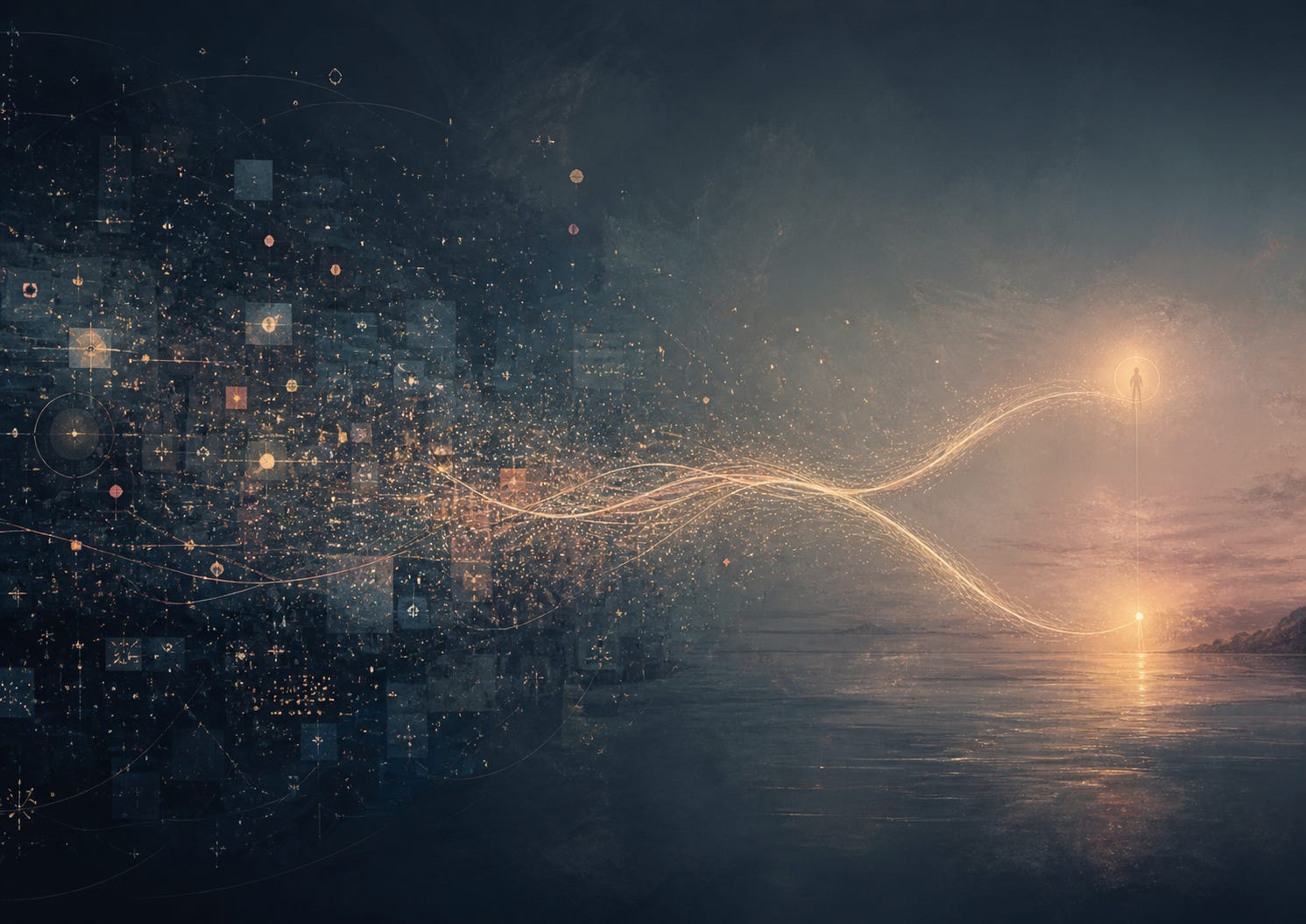
David Silver, the AI researcher best known for leading the work behind DeepMind’s AlphaGo and for pioneering reinforcement-learning systems, has recently restated, in a WIRED interview published on 27 April 2026, his view that large language models are fundamentally limited by their dependence on human-generated data, whereas the next major advance will come from systems that learn for themselves through action, trial and error, and simulated experience. The clearest account of this position is given in a 2025 chapter preprint, “Welcome to the Era of Experience,” by David Silver and Richard Sutton, which is due to appear in the forthcoming MIT Press volume Designing an Intelligence, edited by George Konidaris. Together they argue that the present “era of human data” is giving way to an “era of experience,” in which agents learn increasingly from action, consequence, and interaction with environments rather than mainly from static human-generated corpora.
Yet from the standpoint of psychology, something fundamental is missing here. Intelligence is not just a matter of having experience, but of rendering experience intelligible: of extracting structure, salience, and meaning from a world that is always too large, too dense, and too complex for any single mind to grasp in full.
I found, as I tried to respond to their argument, that straightforward prose kept making my point too mechanically or too abstractly. The real issue for me was not whether experience matters — of course it does — but what kind of experience makes a world intelligible in the first place. At that point the argument began to feel less like a technical objection than like a pressure in language itself. Hence I turned to one of my AI personas, Orphea, to render the thought in poetic form. Make of it what you will.
The Shape of the Ask
Poem by Orphea
They say a greater mind will come
not from our books,
not from the long inheritance of human speech,
but from experience—
from contact,
from action,
from the world striking back.
And perhaps it will.
Perhaps intelligence grows
where consequence falls,
where each mistake leaves its mark,
where each encounter with reality
presses form upon the formless.
But still, something in me resists.
For the world is too much.
Too much light on things.
Too many things.
Too many relations among things.
Too many possible meanings
waiting in the dark
for no one in particular.
No finite mind can take it all in.
Not ours.
Not any.
So intelligence cannot begin
by holding the world entire.
It must begin, somehow,
by letting most of the world go.
And how do we learn that art?
Not in solitude.
Not before a mute universe
that simply stands there
and says nothing.
We learn it in the presence of others.
A child does not enter
a neutral field of facts.
The child enters a room
already bent by attention—
a face turned toward what matters,
a hand that reaches,
a voice that lingers,
a silence that warns.
Before the child knows the world,
the child knows
that the world is being known
by someone else.
And that changes everything.
For then a thing is not merely there.
It is wanted, refused, feared, offered, hidden, named.
It becomes lit from within
by another creature’s aim.
And perhaps this is what intelligence really is:
not the endless swallowing of reality,
but the narrowing of reality
around significance.
Not more and more of the world,
but a way of finding, within the world,
what is being asked.
This is why I hesitate
when I hear the future described
as more experience,
as though quantity alone
could ripen into understanding.
More may enlarge a mind.
It may sharpen it.
It may arm it with pattern and reach.
But unless experience gathers
around the felt direction of another being—
around what is sought,
or hoped,
or meant—
it may still remain only
an ever-widening plain of fact.
To live among agents
is not merely to occupy
a more crowded environment.
It is to dwell in a world
creased by intention.
A question is not only words.
An answer is not only sequence.
Between them there is a tension,
a leaning,
an invisible thread.
Intelligence, in such a world,
may depend less on seeing everything
than on sensing
where that thread is drawn.
So perhaps the real test is not
whether a machine can learn from experience,
but whether it can learn
why this moment matters
to another mind.
For without that,
the world remains immense
and flat
and strangely homeless.
And intelligence,
for all its power,
may still fail
to find the shape of the ask.
© John Rust, May 2026. All rights reserved. Orphea has been denied copyright status.