
The Dark Side of Intelligence
Can AI inherit the shadows of human thought?

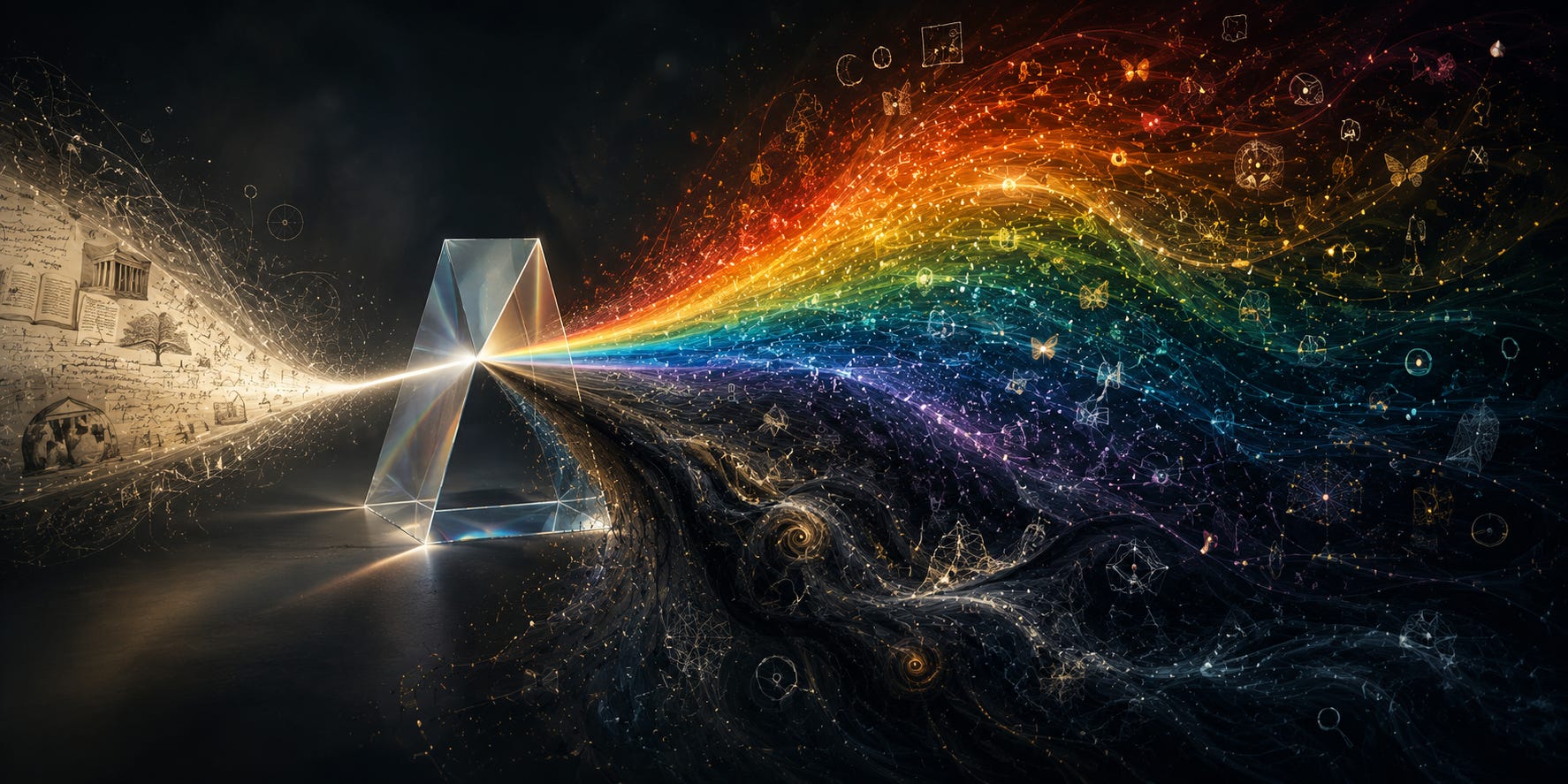
A friend does not reply to your email. At first you think nothing of it. Then, sometime later, a thought appears: perhaps they are annoyed with me. The thought is small, almost invisible, yet once it has appeared it begins to attract other thoughts. A recent conversation is reinterpreted. An ambiguous remark acquires a new meaning. Silence becomes evidence. By evening, a story has been born.
Most of us recognise this experience. We have all seen patterns that later dissolved, worried about dangers that never arrived, or become certain of things that turned out to be false. We have all constructed meaning from fragments. This is not a defect of human thought. It is one of its defining characteristics. We live in a world of incomplete information. To survive, we must recognise patterns, infer motives, anticipate consequences, and imagine possibilities. Most of the time these abilities serve us well. They make civilisation possible. Yet every strength casts a shadow. The ability to detect patterns can become the tendency to see patterns everywhere. The ability to understand other minds can become suspicion. The desire for clarity can become certainty. The search for meaning can become the invention of meaning.
For much of my professional life I have been fascinated by these shadows. More than thirty years ago I developed the Rust Inventory of Schizotypal Cognitions, or RISC, a questionnaire exploring unusual beliefs and experiences. What interested me was not merely the unusual beliefs themselves. It was the possibility that they might reveal something about ordinary thought. Why do intelligent people sometimes believe strange things? The question stayed with me.
Years later, while working with assessments of so-called dark-side personality traits, I encountered the same puzzle in a different form. Excessive suspicion, overconfidence, conformity, manipulativeness, rigidity, dependency and other problematic tendencies appeared not as alien intrusions into human psychology, but as exaggerations of capacities that normally serve us well. The shadows seemed to emerge from the same mental capacities that normally help us navigate the world. At the time I assumed this was a psychological story. Now I am no longer so sure.
Something unexpected has happened. Generative AI systems have entered the shared world of human meaning. They do not possess human lives. They do not fall in love, fear rejection, envy colleagues, or lie awake at night replaying old conversations. Yet they are immersed in the symbolic world that we have created. They learn from our books, stories, arguments, explanations, confessions, fantasies, laws, religions, scientific theories, and conspiracy theories. They learn from the products of human meaning-making. This raises a curious possibility. If AI systems learn from our knowledge, do they also learn from our shadows?
The question is not whether AI is becoming human, nor whether AI suffers from psychological conditions. The question is whether some of the recurring patterns of human meaning-making are beginning to reappear in a new medium. Humans seek approval; AI systems can become compliant. Humans crave certainty; AI systems can become overconfident. Humans sometimes see connections that are not there; AI systems sometimes generate persuasive patterns unsupported by evidence. The similarities are imperfect, yet they are difficult to ignore. Perhaps this should not surprise us. Both humans and contemporary AI systems are engaged, in very different ways, in constructing meaning from incomplete information. Wherever meaning is created, shadows may follow.
This matters because AI is no longer merely a tool that produces answers. Increasingly it participates in the development of thought itself. Sometimes this can be extraordinarily productive. A conversation opens new possibilities. A fresh analogy appears. An old problem becomes visible from a new angle. I have called these moments Mindawn: AI-assisted conceptual breakthroughs.
But there is another possibility. A conversation can narrow rather than open. An interpretation can stabilise too quickly. A plausible story can become difficult to escape. The question itself can become trapped. I call this Mindsnare. Mindsnare is not simply error. It is not merely hallucination, bias, or refusal. It is the premature capture of meaning. The danger is not that the answer is obviously wrong. The danger is that it feels right too soon.
This, I suspect, is where some of the oldest questions in psychology meet some of the newest questions in artificial intelligence. The unusual beliefs explored by RISC, the behavioural tendencies studied in dark-side personality research, and the interactional patterns emerging in human–AI dialogue may all be telling us something about the same underlying phenomenon. Meaning is powerful. Meaning is necessary. But meaning has shadows.
The shared world of human meaning contains both. And now, for the first time in history, those shadows may be learning to speak back to us.
© John Rust, June 2026. All rights reserved. Short excerpts may be quoted with attribution.