
The Case of the Missing Question Mark
A detective story about a lost question mark, a suspicious archive note, and the danger of answers that arrive too soon

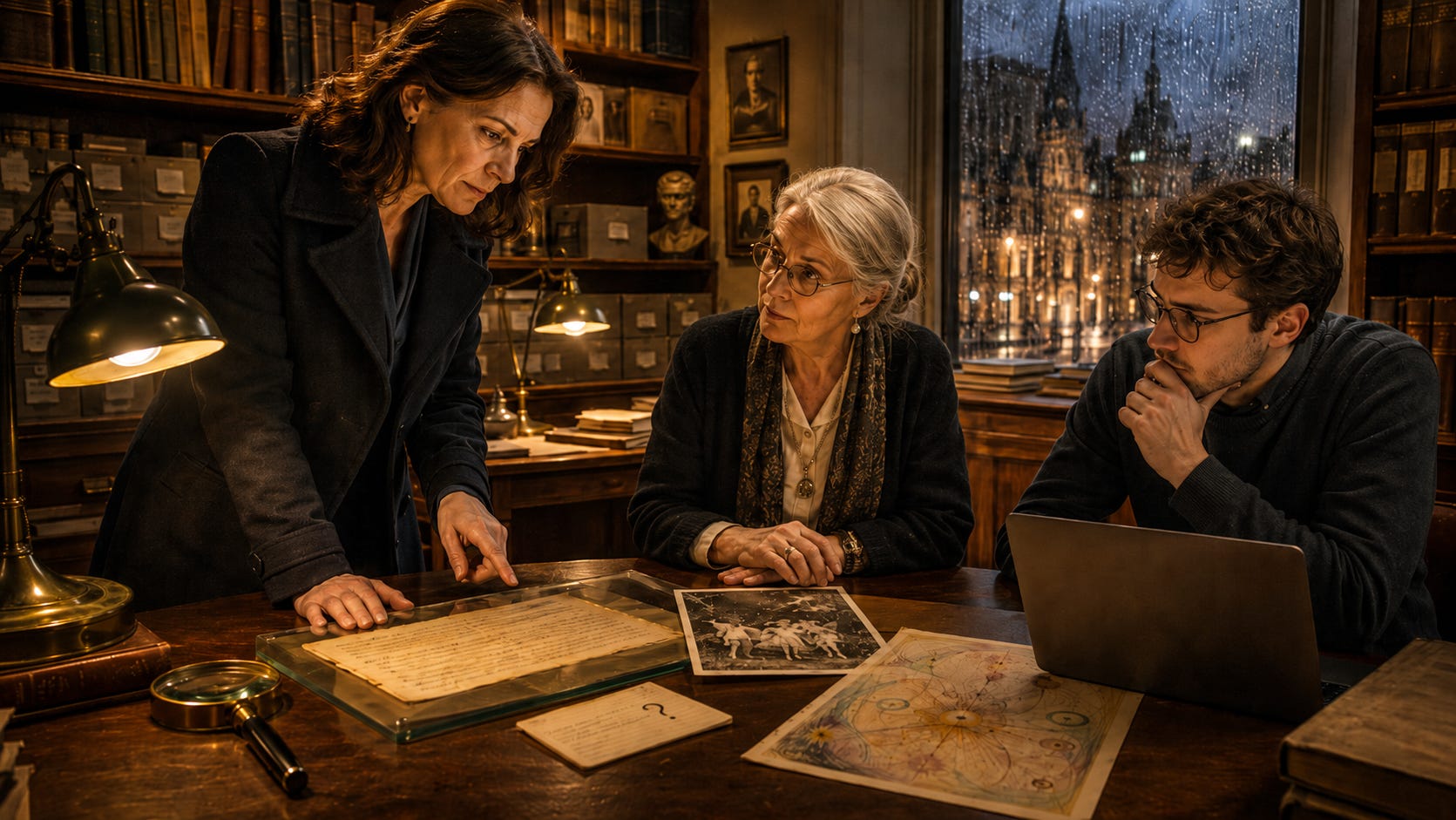
Preliminary Note: This Substack is a companion piece to my webpage The Ask Between Us, where I develop the idea that intelligence itself is partly interactional, not merely a possession of individual brains or machines. Some intelligent structure may arise in the interstices between participants — in the unfolding pattern of question, response, correction, hesitation, recognition, and redirection.
Here I have approached the same problem differently: as a detective story. This is part of a wider experiment in making my research more accessible to a broader public. In recent months I have explored ideas of using AI generated short stories, dramatic scripts, fictional dialogues, poems, abstract images, and even music, Some have worked better than others; the songs should mercifully remain a matter for private judgement.
The point is not merely to decorate the research. These forms also test one of its central claims: that generative AI, when used through carefully shaped personas, can help dramatise ideas that might otherwise remain trapped in rather turgid academic prose. In this case, AI agents Athenus, Skeptos and Orphea helped turn a technical question about dialogue, premature closure, and “intelligence attractors” into a small mystery about a missing question mark.
The story is fictional. The problem is real: how easily questions can be closed too soon, and how genuine inquiry remains answerable to what is real.
The Case of the Missing Question Mark
The first thing Mara Vale noticed was that the note was too beautiful.
Not physically. Physically it was ordinary enough: one sheet of yellowed paper, soft at the corners, folded once and then flattened badly. The ink had faded to brown. A faint line of dust marked the crease. It had the modest, tired look of something that had been ignored for a long time.
But the sentence itself was beautiful, and that made it dangerous.
Dr Eleanor Harcourt, archivist of the College of Psychic Studies, watched Mara read it beneath the glass.
The true question is not answered; it opens a path. Followed faithfully, it draws the mind toward what is real.
Mara read it twice.
Outside, South Kensington was darkening into rain. The reading room overlooked Queensberry Place, where the traffic passed in muted red and white streaks. Inside, the College was quiet after closing, full of the particular silence of old institutions: not empty, exactly, but listening.
“Well?” Harcourt asked.
Mara stepped back from the table.
“It sounds like something someone badly wanted to find.”
That was why Harcourt had called her.
Mara Vale had once worked in the Metropolitan Police art and antiquities unit. Now she investigated difficult papers for museums, libraries, families, and occasionally people who had bought expensive manuscripts from men with too much confidence. She had seen forgeries made from greed, vanity, grief, scholarship, inheritance disputes, and love. Love was often the worst. Love made people careless.
On the table, beside the note, Harcourt had laid out three other objects. A photograph of the Cottingley fairies. A water-colour from a spiritualist art exhibition. And an old catalogue card.
Mara looked first at the fairies. The little figures danced in the grass, absurd and charming, paper creatures pretending to be revelations. They seemed less fraudulent than eager, as though they had run into belief and been unable to stop.
“The note was found where?” she asked.
“In a box of miscellaneous spiritualist correspondence,” said Harcourt. “It had a loose Doyle association. Conan Doyle spoke here, corresponded with people here, supported causes and claims we would now handle rather differently.”
“Was the note attributed to him?”
“That depends what you mean by attributed.”
Mara smiled faintly.
“Good. Then we may still be in the land of evidence.”
Harcourt handed her a folder. The note had first appeared in an uncatalogued box during a volunteer sorting project. A doctoral researcher, Daniel Marsh, had then scanned it for a thesis chapter on spiritualism, artificial intelligence, and the human desire to hear voices from beyond the ordinary. From there it had travelled too quickly: an internal email, a research group, a conference abstract, and then, disastrously, a social media post from someone who should have known better.
The phrase had caught fire.
The true question is not answered; it opens a path.
Within three days it had been quoted as “possibly Conan Doyle.” Within five, as “a remarkable late reflection by Conan Doyle.” By the end of the week, one blogger had called it “a Victorian anticipation of human-AI dialogue.”
“That,” said Mara, closing the folder, “is a lot of weather for one scrap of paper.”
Harcourt removed her glasses and rubbed the bridge of her nose.
“Do you know what it would mean for this place if it were genuine?”
“Yes.”
“And do you know what it would mean if we allowed people to think it was genuine when it isn’t?”
“Yes.”
Harcourt put her glasses back on.
“That is why you are here.”
Mara bent over the old catalogue card. It was small, foxed, and written in blue ink by someone who had preferred abbreviations to clarity.
Misc. spiritualist corr. Doyle? Besant? Houghton? Unsorted.
Mara stared at it for a long moment.
There it was: the smallest hook in the case.
A question mark.
Not proof. Not yet. But a little hinge on which certainty might later swing.
“Where is Daniel Marsh?” she asked.
“Downstairs. He is frightened.”
“Good,” said Mara. “Frightened people sometimes tell the truth.”
Daniel Marsh was in his late twenties, narrow-shouldered, intelligent, and visibly exhausted. He arrived carrying a laptop as if it might either save or condemn him. He had the strained politeness of a young academic who had not slept properly since Tuesday.
“I didn’t forge anything,” he said before sitting down.
“No one said you did.”
“You were thinking it.”
“I think many things,” said Mara. “Most of them do not survive contact with evidence.”
That unsettled him more than an accusation would have done.
He explained the scan, the transcription, the AI enhancement tool. The handwriting had been faint. The software had improved contrast, suggested readings, and produced a draft transcription with uncertain words bracketed. Daniel had checked it against the image. He had not checked it against the original.
“Why not?”
He looked at Harcourt, then at the table.
“Because the reading made sense.”
Mara waited.
“And because it was good,” he added. “It said what I was trying to say, only better.”
There it was: not guilt, but desire.
“What was the original machine transcription?”
Daniel opened his laptop. His fingers hesitated before he turned the screen toward her.
The early transcription read:
The true question is not [answered at once?]; it opens [a path of inquiry?]. Followed faithfully, it draws the mind toward [truth? the real?].
The later version, the one now circulating, had lost the brackets. It had also lost the hesitations. It had become clean, memorable, quotable.
A sentence fit for belief.
Mara looked again at the fairy photograph.
“Who removed the brackets?”
Daniel swallowed.
“I did.”
“Why?”
“They made it look uncertain.”
“It was uncertain.”
“I know that now.”
“No,” said Mara. “You knew it then. You merely hoped uncertainty would be untidy enough to ignore.”
Harcourt said nothing. But Mara saw the archivist flinch, and understood that Daniel had not been the only one who had wanted the note to hold.
They returned to the reading room in silence.
Mara asked for the original box. Harcourt brought it herself. It contained letters, programmes, lecture notes, receipts, newspaper cuttings, and several fragments of handwriting with no obvious author. The box did not feel like a secret cache. It felt like an afterlife for paperwork: things once important enough not to throw away, but not important enough to sort.
Mara worked slowly. She compared paper. She compared ink. She traced catalogue entries through three systems: the card, a 1990s database, and the current archive platform.
The first card said Doyle?
The database said Doyle/Besant/Houghton material.
The current platform said Associated person: Arthur Conan Doyle.
A question had become a category. A category had become a fact.
At half past seven, Harcourt brought coffee. Daniel had gone quiet. Rain worked softly at the windows.
Mara placed the card beside the note.
“No one needed to forge this,” she said at last. “It was made false by being made too certain.”
Daniel stared at her.
“The note itself may be old,” she continued. “The thought may even be interesting. But the Doyle connection is unsupported. The transcription was over-cleaned. The doubtful words were regularised. The brackets vanished. The question marks vanished. Then everyone admired the result because it gave them exactly what they needed.”
Harcourt looked toward the water-colour.
“And what did they need?”
Mara followed her gaze.
The painting was all motion: fine streams of colour rising and looping, crossing one another without collapsing into a single figure. It did not prove anything. That was almost its dignity. It offered pattern without pretending to be evidence.
“They needed the past to bless the present,” Mara said. “They needed a Victorian voice to say that their modern question was not merely fashionable.”
Daniel sat down heavily.
“So it is worthless.”
“No.”
He looked up.
“That is the irritating part,” said Mara. “Worthless would be easier.”
She moved the fairy photograph closer to the note.
“The fairies were false. Paper cut-outs. A trick. But they were not powerless. They drew belief, books, reputations, shame, wonder. They were a false answer, but a strong attractor. They pulled thought inward, toward what people wanted to be true.”
Then she touched the edge of the abstract painting.
“This is different. It does not close the case. It does not say, ‘Here is proof.’ It says, perhaps, ‘Here is something trying to appear.’ That may be useless as evidence, but it is not the same sort of falsehood.”
Harcourt’s face changed slightly. Not agreement yet, but recognition.
“And the note?” she asked.
“The note began as uncertainty. Then people improved it until it became a false answer.”
Daniel said, quietly, “I only removed the brackets.”
Mara looked at him.
“Most falsehoods begin with an only.”
No one spoke for a while.
At eight o’clock, Harcourt turned on a desk lamp. The yellow pool of light drew the objects together: fairy, painting, note, card. Four little witnesses. None of them sufficient alone.
Mara opened Daniel’s laptop again. In his notes she found comments from a retired Cambridge professor whom Daniel had consulted. He had used three named AI interlocutors as part of his thinking process. Mara had little patience with theatrical naming, but the notes were brief enough not to annoy her.
Athenus: Conceptually coherent; provenance weak.
Skeptos: The evidence is most dangerous where it is most welcome.
Orphea: It may be false as evidence and true as a question.
Mara read the last line twice.
“That one,” she said, “understands archives.”
Harcourt smiled for the first time that evening.
Mara closed the laptop.
“There is one more thing,” she said. “Why did the sentence attract you? Not you personally, Daniel. All of you. Why this sentence?”
“Because it says questions matter,” Daniel replied.
“No. Many sentences say that.”
“Because it says questions open paths.”
“Better.”
Harcourt said, “Because it suggests that a question can lead toward something real.”
“Yes,” said Mara. “That is the heart of it.”
She stood and went to the window. The rain had stopped. Across the street, wet leaves shone under a lamp. She thought of eyes — not as metaphor, but as evidence. Eyes had evolved more than once in distant branches of life. Not because evolution had imagined a perfect form, but because the world contained light, motion, edges, distance, danger, food. The world offered structure. Life became answerable to it.
That was different from the fairies. The fairy photograph pulled belief toward desire. The eye was disciplined by reality.
She turned back to the table.
“A false clue ends an investigation too soon,” she said. “A true clue does the opposite. It makes the question better.”
Daniel frowned.
“What does that have to do with intelligence?”
“Perhaps everything.”
Mara took one of Harcourt’s blank archive slips and wrote carefully, resisting the temptation to make the sentence too polished.
A false attractor gives us the answer we want too soon. A truer one keeps the question alive long enough for the world to correct it.
She paused, then added beneath it:
Intelligence is not shown by an answer’s fluency, but by whether inquiry is drawn onward while remaining answerable to what is real.
Harcourt read the slip.
“That is not a conclusion.”
“No,” said Mara. “It is a restored question mark.”
The archive record was amended that night. Harcourt insisted on doing it herself.
Formerly associated with Conan Doyle material through uncertain catalogue notation. Attribution unsupported. AI-assisted transcription and subsequent editing removed uncertainty markers. Retained as an example of archival drift, interpretive overreach, and the conversion of provisional reading into apparent evidence.
Daniel watched her type it. His face was pale, but clearer.
“What happens to my chapter?” he asked.
“You rewrite it,” said Harcourt. “And it becomes better.”
He looked doubtful.
Mara put on her coat.
“Start with the mistake,” she said. “Readers trust a recovered question more than a borrowed certainty.”
She left them in the reading room: the archivist, the student, the note, the fairy, the drawing, and the small restored mark of doubt.
Outside, South Kensington smelled of rain and stone. The city had not disclosed itself. Cities hardly ever did. They offered signs, surfaces, reflections, doors.
At the corner, Mara looked back once at the College. The windows glowed above the street, neither mystical nor ordinary, but something in between: a house full of questions that had survived their answers.
Her phone buzzed. A message from Harcourt.
We have restored the question mark.
Mara slipped the phone into her pocket and walked toward the Underground.
Some cases end with a culprit.
This one ended with a punctuation mark.
But as Mara knew better than most, a question mark in the right place can save the truth from arriving too soon.
© John Rust, May 2026. All rights reserved.
Written through dialogue with Athenus, Skeptos and Orphea, who provided more than assistance and less than legal authorship. Conan Doyle is present here as atmosphere and historical temptation, not as author. The copyright rests with John Rust; the unease about that arrangement is part of the story.