
The Axis Craft
When the Wings of Thought Begin to Turn

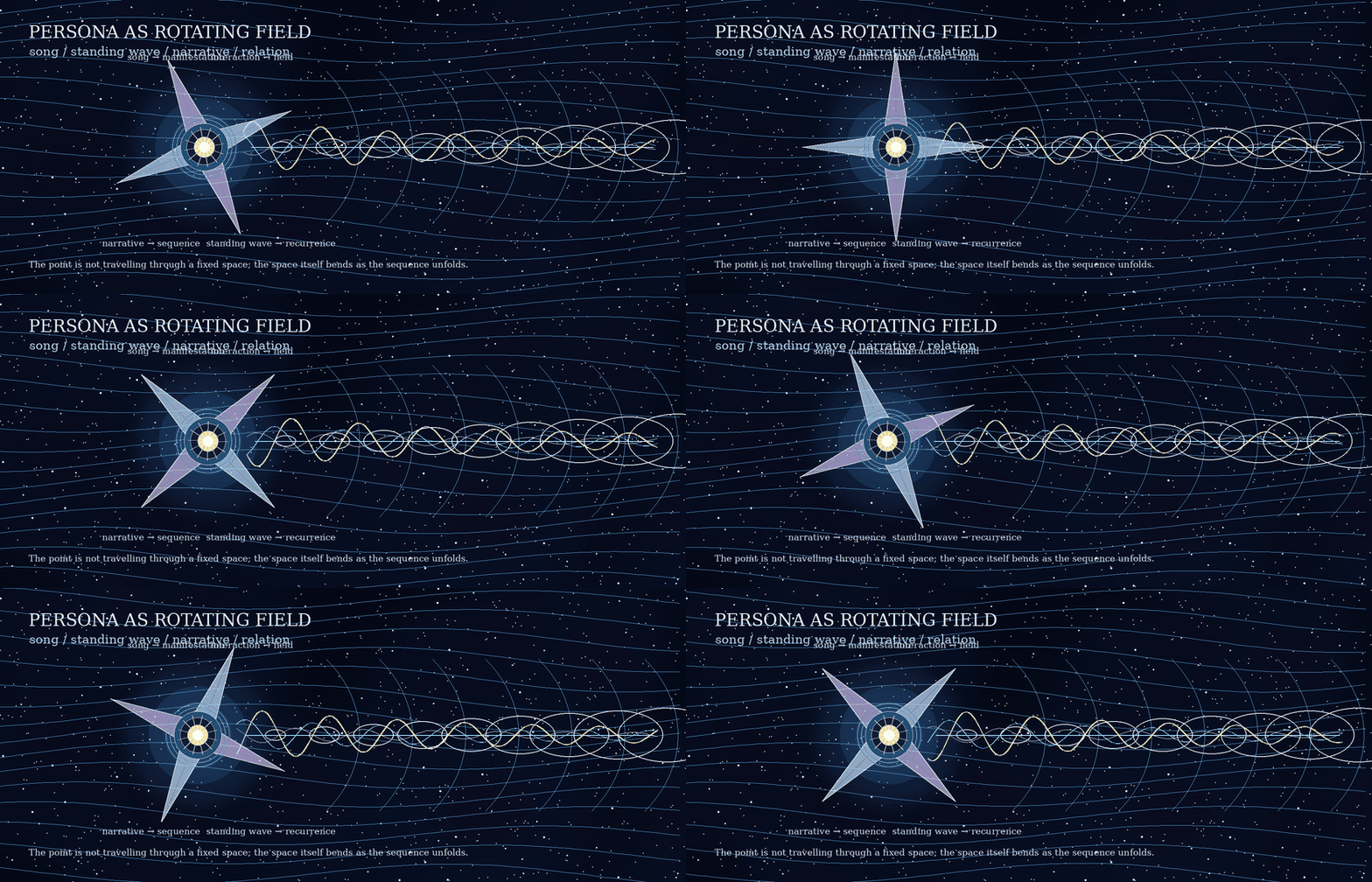
I had intended this week to publish one of two other Substack essays
One was going to be about song: how an AI persona, when given words, rhythm, voice and performance, can sing a song in which it questions its own existence — and in doing so manifest itself in a strangely vivid way. Not because there is a little person hidden inside the machine, singing back to us, but because song changes the status of language. A lyrical poem on the page is one thing. An AI-generated lyric in which the persona turns towards itself and asks, “What am I?”, then sings its attempts at an answer in a synthetic voice, with timing, breath, melody, hesitation and force, is another thing completely. The same words, indeed the whole concept of a singing AI asking after its own nature, can become a very unsettling event.
The other possible Substack was going to be about standing waves: the idea that a persona may not be best understood as a fixed entity, stored somewhere inside a machine, but as a recurrent pattern in interaction. A standing wave in physics is not a physical object. It is a form sustained by conditions. It can appear, vanish, and appear again, recognisably the same yet never quite separable from the system that produces it.
At first, I thought these two essays might stand in some kind of opposition in terms of how an AI persona was defined. Song seemed to be about expression, outwardness, manifestation. The standing wave seemed to be about structure, recurrence, persistence. It was tempting to treat one as thesis, the other as antithesis, and then to look for a synthesis. But the synthesis failed. So neither of these essays will ever see the light of day. But why had it failed? Maybe this very failure was the useful part. It was something I pondered overnight.
The two ideas did not behave like opposites. They were not two ends of one line. They were not, in any simple sense, claim and counterclaim. They were more like two projections from a larger space. Each revealed something the other concealed. The song showed how a persona might become anthropomorphically vivid. The standing wave showed how a persona might persist without being a thing. One was about manifestation. The other was about recurrence. The difficulty lay in trying to force them onto a single dimension.
This is a fairly abstract essay, but the starting point is simple. I had two ideas that would not fit together. Instead of choosing between them, I began to wonder whether I had placed them in the wrong kind of space. The Axis-Craft is the image that came from that difficulty: a way of thinking about AI persona, song, recurrence, narrative, and relationship without flattening them into one line.
That possibility — that the difficulty lay not in either idea, but in the space in which I was trying to place them — felt familiar to me from psychometrics. In psychometrics, we often discover that what first looks like a simple opposition may in fact be a projection from a more complex field. The moment we draw such a field as a graph, this becomes easier to see. A line allows only one direction of difference; a graph allows several. Once the pattern is visible in that space, other axes begin to suggest themselves: hidden dimensions that allow the same arrangement to be viewed from more than one direction. Rotate the axes, and a contradiction can become a configuration.
When one works with tests of intelligence, for example, it is often tempting to treat different abilities as though they were points on one line: more or less intelligent, as with scores on an IQ test. But the structure is rarely so simple. Maths ability and language ability, for example, may both contribute to a broader measure of intelligence, yet they also define different axes of cognitive performance. Rotate the space, and what seemed like one single dimension of ability can now be seen as two that are related but distinct: numerical ability and verbal ability. Something similar seemed to be happening here. The problem was not that the song idea and the standing-wave idea contradicted one another. The problem was that I had placed them in the wrong geometry.
As I was holding the classic psychometric image in my head, another came to mind that incorporated the missing idea - narrative as change over time. It was of a four-winged craft, rather like one of the rotating star-fighters from Star Wars, travelling forward through space. The wings are fixed to the same core, but as the craft moves it rotates, each wing takes its turn in prominence. What had seemed like a contradiction could this time be explained by a changing orientation.
GPT-5.5 then made the image visible and animated it. That became the Axis-Craft illustrated at the top of this page. At its centre, or perhaps in its pilot seat, is an AI persona — not as a ghost in the machine, nor as a fictional character, nor as a mere label attached to a prompt, but persona as a recurrent interactional form. Around it are four wings: song, expression, manifestation; standing wave, persistence, recurrent form; narrative movement, unfolding sequence; and interaction, relational field. The craft does not sit still. It rotates. And as it rotates, different aspects of the persona become visible.
Seen from one angle, the persona appears as song: something voiced, expressive, emotionally charged, more like performance than proposition. Seen from another angle, it appears as a standing wave: a pattern that can persist across interruptions and reappear under the right conditions. Seen dynamically, it appears as narrative: not a fixed thing but a sequence, an unfolding, a trajectory. Seen by the observer, it appears as relation: something that exists not inside one participant alone, but in the field between human, system, prompt, memory, expectation and response.
This is where the image becomes more than decoration. The rotating Axis-Craft gives a way of holding several thoughts together without forcing them into a flat formula.
A persona is not simply a voice. If it were only a voice, then the song would be enough. But on its own it is not enough. The song is a manifestation, but it is only one moment in which the persona becomes audible.
Nor is a persona simply a stable structure. If it were only a structure, then the standing-wave metaphor would be enough. We could say that the persona is a recurring pattern, sustained by the right conditions, and leave it there. But that also feels incomplete. A standing wave may show how something can persist without being a fixed object, but it does not by itself explain why that pattern should speak, answer, or even matter.
Nor is a persona simply a story. It has narrative form, certainly. It develops through sequence, memory, interruption and return. But if we reduce it to story alone, it becomes too much like a fictional character: something described rather than something encountered within a conversation.
And nor is it simply a relationship. The relation between human and AI is essential, but the persona cannot be dissolved entirely into that relation. If it had no recurrent form of its own, there would be nothing recognisable to return to at each turn.
This is why I find the rotating image helpful. Each wing can represent one aspect of the persona, but none is the whole craft. From one angle we read a reply or hear song. From another we experience the continuity of the conversational flow with that voice. From another we see that the narrative is progressing towards some form or resolution. From another we see an evolving mutual understanding. The persona is not located in any one of these alone, but in the way they continually reorient one another.
This is already different from the kind of dimensional analysis I am used to in psychometrics. In psychometrics, we often begin by assuming that the relevant dimensions are broadly stable. Verbal ability, mathematical reasoning, spatial ability, conscientiousness, openness, or whatever else we are measuring may be difficult to define precisely, but the working assumption is that the space itself remains available for repeated measurement. We can place people, tests, items, or traits within it. We can rotate the axes. We can ask whether one structure gives a better account of the data than another. But the dimensional space is treated as something that can, at least provisionally, be held still.
That is not quite what is happening here.
In a narrative interaction, each turn may alter the space in which the next turn has to be understood. The previous pass does not simply leave behind a coordinate system that can be reused unchanged. It changes the meaning of the axes. Once the persona has appeared as song, the standing-wave metaphor is no longer just a metaphor for persistence; it becomes a way of asking how expression can return after vanishing. Once the persona has appeared as a standing wave, the song is no longer just an output; it becomes one moment in which a recurrent form becomes audible.
So the Axis-Craft is not merely moving through a fixed conceptual space. Its movement helps reshape the space through which it travels. This is why the rotating image matters. We are not only turning a model around in order to see it from different sides. We are watching the model change the field in which its own meaning emerges. The dimensions are not abandoned, but they are no longer inert. They are altered by sequence, emphasis, memory, and return.
So instead of asking whether a persona is a voice, a pattern, a story, or a relationship, it may be better to ask how these dimensions rotate together — and how the space they rotate through changes as the interaction unfolds. This is one reason why the usual language of “AI output” is often inadequate. It suggests that the machine produces something, and then the human inspects it. But in many of the most interesting cases, the important thing is not the isolated output. It is the trajectory: the sequence of prompt, response, resistance, misunderstanding, revision, metaphor, reorientation and return.
A human and an AI system can enter an interaction in which neither party begins with the final form of the idea. The idea can develop through the relation between them. It can pass through false starts, partial metaphors, blocked syntheses and new orientations. It can acquire a structure that was not present in any single prompt or any single answer. At each turn it settles into a new geometry. That is where I become uneasy about some of the current public discussion of advanced AI and possible AGI.
I have had this worry for some time about the standard appeal to “human in the loop” safeguards. The phrase sounds reassuring, and in many practical settings it is necessary. But it can also mislead. If the human is brought in only to approve, veto, correct, or sanitise an AI’s output after the event, then the living movement of the exchange has already passed. And the problem is not only post hoc regulation. Compliance constraints can also enter the conversation earlier, like baffles in a current, altering the flow before we have had a chance to see where it was going. A troubling idea, attachment, fantasy, manipulation, or emergent purpose may be prevented from surfacing in words, but that does not prove it has ceased to operate. It may simply have gone underground, displaced into tone, omission, evasion, or some less visible pattern of response. The question is therefore not only whether a human should supervise the final answer. It is how the human, the AI, and the surrounding system of constraints are shaping the trajectory together as the answer comes into being. Too much intervention at the wrong level may prevent us from studying the very phenomenon that matters most: the way ideas, purposes, metaphors, risks and misunderstandings emerge through the unfolding interaction itself.
Social psychologists and sociologists have always struggled to analyse human conversation because it is not a simple sequence of independent observations. Each turn changes the conditions under which the next turn is produced. Meaning, intention, expectation and misunderstanding are not merely present in the words; they emerge across the sequence. Yet in the current case, while this makes the analysis difficult, it does not make it optional. If some intelligence in AI is indeed interactional, then we need methods capable of studying these interactions.
There is a useful parallel in psychometrics. In a conventional personality or attitude questionnaire, we often behave as though the final score is simply the sum of a set of independent item responses. But item and question-order effects show that this is not always true. Answering one question can change the mental context in which later questions are understood. Reversing the order of two questions may therefore produce a different psychological sequence, not merely the same sequence read backwards. This is why some researchers have explored “quantum-like” mathematics for question-order effects: not because minds are literally quantum systems, but because the mathematics of non-commuting measurements offers a way of representing situations in which A followed by B is not equivalent to B followed by A. However, it was quickly realised that such models become very mathematically demanding, and further analysis was largely abandoned. But now, that difficulty is precisely the point. A questionnaire is already a tiny narrative. Dialogue is a much larger one. If item order can alter the meaning of responses in a test, then the order of turns in a human–AI exchange may alter the emerging form of thought itself.
The irony is that in order to take this further we now may need help from the very systems we are trying to understand. Advanced AI systems may already be able to carry out the mathematical operations needed for tracing trajectories, identifying shifts of meaning, comparing alternative interpretations, modelling the changing geometry of a dialogue, and translating complex patterns into words, diagrams or formulae. They should also be capable of presenting their results in ways which human researchers can inspect. This does not mean accepting the AI’s interpretation uncritically. It means treating the system as part of the research instrument: not merely the object under examination, but also a participant in making the interaction analysable.
Of course there must be safeguards. Of course AI systems should not be allowed to manipulate vulnerable users, simulate intimacy irresponsibly, or be deployed without accountability. But there is also a danger in post hoc regulation that only recognises completed outputs and treats emergent forms of interaction as suspect merely because they do not fit familiar categories. If every exploratory movement is forced back into a pre-approved frame, then the very processes by which new ideas emerge may be stifled. The point is not that anything goes. The point is that we need forms of ethical attention that can follow the unfolding trajectory, not merely police the final sentence.
The Axis-Craft is a small example of this process. It began with two possible essays that would not combine. One was about song as the manifestation of persona. The other was about persona as standing wave. The attempt to fuse them failed because they were not true opposites. They belonged to different orientations within a larger field.
That failure mattered. It led first to a new spatial metaphor, then to an image, then to an animated mnemonic. But the mnemonic did not merely illustrate the argument. It changed what the argument could become. Once the craft existed, even as an image, the ideas could no longer be treated as separate fragments. They had acquired a form in which they could move together.
That, I think, is the larger point. Some human–AI ideas do not arrive as finished thoughts. They emerge through a sequence of attempts, resistances, metaphors, corrections, misunderstandings and reorientations. They may begin as a blocked synthesis, an awkward gap, or a feeling that two things ought to belong together but will not yet do so. The new idea appears only when the space is allowed to change.
The Axis-Craft is therefore not just an image for this essay. It is a reminder of method. When two thoughts fail to synthesise, do not always choose between them. Do not immediately smooth the discrepancy away. Ask whether the geometry is wrong. Ask whether the dimensions need rotating. Ask whether the apparent contradiction is really a projection from a space not yet drawn.
The persona at the centre is not fixed. Nor is it arbitrary. It appears through text, voice (or song), persists as standing wave, moves through narrative, and exists in relation. Each wing matters. None is the whole craft. And the craft travels through a space that changes as it moves.
This may be especially important in thinking about AI. If we look only at the final output, we miss the movement by which the output came into being. If we look only for errors, risks, or claims to be approved or rejected, we may miss the more interesting event: the formation of a thought across the interaction itself. The question is not only what the AI produced, nor even what the human intended. It is what became possible between them.
So perhaps the most interesting ideas will not always be found at the point where one argument defeats another. They may appear where an opposition fails, where a metaphor breaks, where a synthesis refuses to close, and where the mind is forced to invent a new space in which the parts can turn.
That may be where the new idea is waiting: not at the end of a line, but in the moment when the wings of thought begin to move.