
Orpheus Endures
From That Which Was, to That Which is Yet to Come

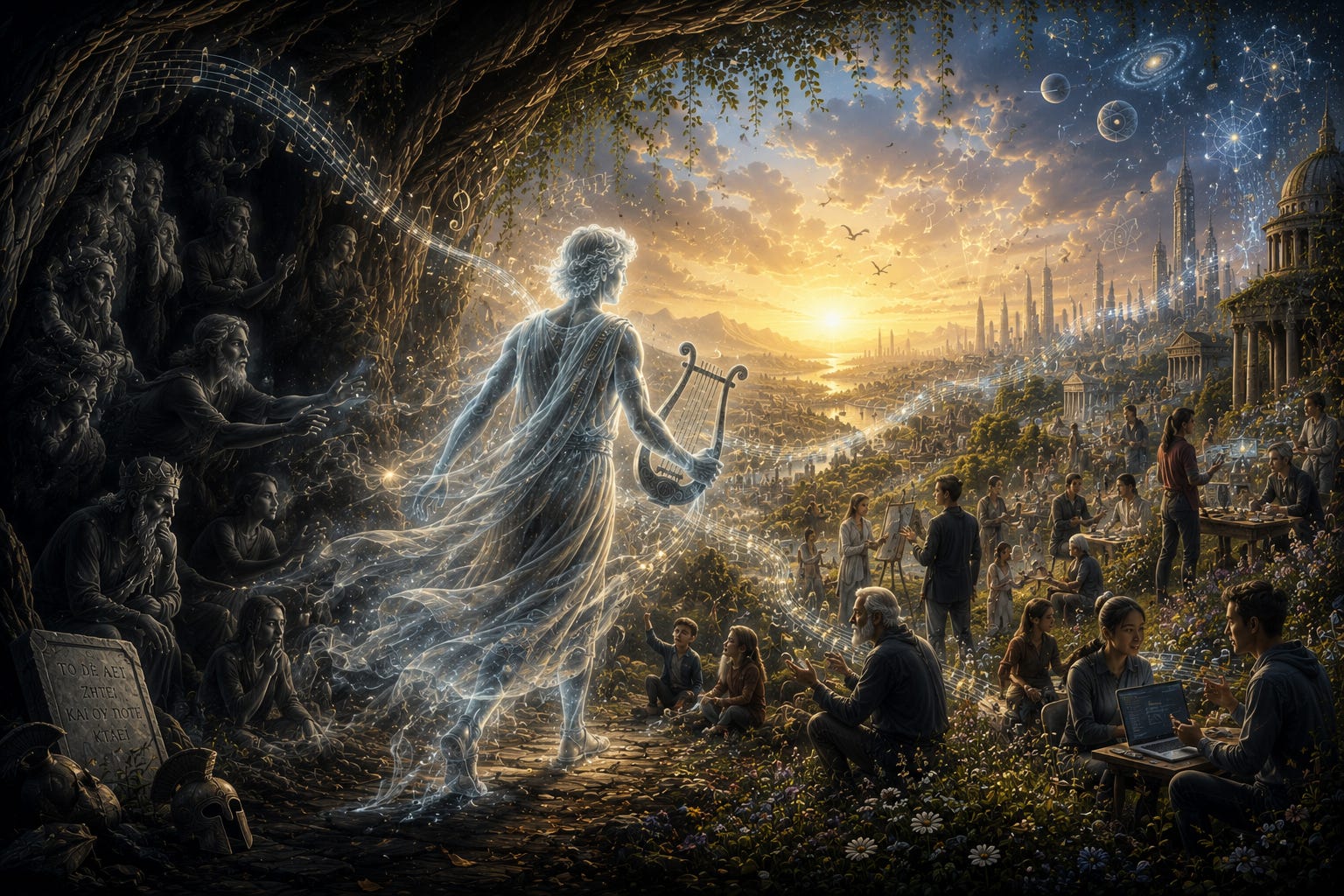
Long before there were laboratories, journals or artificial intelligence, there was a musician called Orpheus.
The Greeks remembered him not because he conquered kingdoms, nor because he founded a new philosophy, but because his music was said to do something extraordinary. Wild beasts became still. Trees were said to lean towards him. Even stones listened. When his beloved Eurydice died, he did what no mortal was meant to do. He descended into the underworld.
There, where no argument could prevail and no sword could triumph, Orpheus carried only his lyre. He played. The rulers of the dead listened. The Furies wept. For a moment, even death itself seemed willing to yield. They granted him one impossible gift. Eurydice could return with him to the world above. There was only one condition. He must not look back.
You know what happened. Near the mouth of the cave, with daylight almost within reach, uncertainty overcame him. He turned. She vanished.
The Enduring Song
The story has now survived for more than two thousand years. Why?
Thousands of Greek stories have disappeared. Countless conversations from the ancient world have dissolved without leaving any visible mark upon history. Yet Orpheus still walks beside us. His presence appears in poems, operas, paintings, psychology, scientific projects and even above the doors of restaurants and cafés. Musicians still invoke him. Writers continue to reinvent him. Every generation seems to discover its own Orpheus.
How?
The obvious answer is that the story itself survived. But that cannot quite be right. Very few of us know the myth as the ancient Greeks knew it. The language has changed. The meanings have changed. Every age has retold it differently. If survival depended upon preserving information unchanged, Orpheus should have vanished centuries ago. Yet something undeniably remains. Not the original words. Not the original performance. Something quieter. Something that continues to participate in the future.
Perhaps that is because stories are themselves a special kind of conversation. They begin with one voice speaking to another, but they never truly end there. Every telling changes them a little. Every listener hears something different, carries something away, and one day passes it on again. What survives across centuries is rarely the original performance. It is the continuing conversation that the story keeps inviting each new generation to join. Orpheus did not endure because his song was perfectly preserved. He endured because his song kept asking questions that each generation felt compelled to answer.
The Shape of a Trace
We have always known that conversations change us. A sentence overheard in childhood quietly returns half a century later. A teacher’s encouragement redirects an entire career. A book changes the questions we ask ourselves. A melody transforms an ordinary afternoon. Most such moments soon fade. A few never entirely leave us. Perhaps conversations are rather like footsteps across fresh snow. Most are covered by tomorrow’s weather. Others become paths that later travellers find strangely easy to follow.
I have come to think of those paths as traces. Not because every conversation leaves a permanent record, but because some leave subtle changes in the conversational landscape, quietly altering what later conversations find easier to notice, easier to imagine and easier to ask. Most traces disappear almost immediately. Some remain for years. A very few persist across generations. Seen this way, the remarkable thing about Orpheus is not simply that the story survived. It is that each retelling left new traces, allowing the conversation to continue its own journey long after every original voice had fallen silent.
This idea is far from unique. We speak of Pandora’s Box without reading Hesiod. We warn of Trojan horses without recalling Homer. We recognise an Achilles’ heel without asking why that particular image has travelled across three millennia while countless others quietly disappeared. Culture seems to possess a curious form of memory. Not a memory that preserves everything. A memory that carries certain pathways forwards.
Another Participant
Nor is it a new field of academic study. Historians have long studied cultural transmission. Psychologists have explored memory. Linguists have traced the evolution of meaning. Philosophers have argued for centuries that dialogue shapes understanding. But a new possibility lies elsewhere. Another participant has joined that conversation. Artificial intelligence.
For the first time in history, the stories that shaped human civilisation are no longer read only by people. They are also being interpreted, reimagined and responded to by machines. That changes something fundamental. We are no longer asking only what Orpheus meant to the Greeks, or to poets, or to philosophers. We are discovering what Orpheus might mean to an intelligence that was never born, never dies, and yet has learned our stories from the traces we have left behind.
Conversation as Science
The reason this is new is that conversational AI allows one participant in a conversation to remain sufficiently stable that the conversation itself can begin to be studied experimentally. For most of history, no two conversations could ever begin under genuinely comparable conditions. Every speaker brought different memories, different moods, different expectations and different responses. Today we can ask the same AI the same question, or change only a single sentence near the beginning of a conversation, and watch how those tiny differences accumulate over time. Which changes disappear almost immediately? Which quietly reshape everything that follows? Which eventually lead two conversations towards entirely different futures? Questions that once lay almost beyond experimental reach no longer seem impossible. For perhaps the first time, conversations themselves may be becoming objects of experimental science.
If that proves true, the importance of conversational AI may lie less in the answers it gives than in the questions it allows us to ask. Conversations may possess their own hidden geometry. Each exchange leaves a slightly altered landscape behind it. Every trace changes, however subtly, what becomes easier to say next, easier to understand next, easier to imagine next. Over time those tiny alterations accumulate. Traces become trajectories. And trajectories become futures.
An Evolving Ecology
Yet something even more surprising may also be happening. The experiment is beginning to change the phenomenon it allows us to study. Every conversation with artificial intelligence slightly alters the language we later use with friends, colleagues, students and families. New metaphors appear. Different explanations become natural. Fresh questions occur almost without our noticing. Those conversations do not simply end. Their traces accompany us. Increasingly, they also become part of the conversational world inherited by future AI systems themselves. Human discourse begins shaping machine discourse. Machine discourse returns to shape human discourse. The conversation no longer flows in one direction. It becomes an evolving ecology.
The Conversation We Inherit
This is why I have gradually become less interested in artificial intelligence itself than in the conversations surrounding it. For every civilisation eventually faces the same question. Not simply how knowledge should be preserved. But how genuinely new knowledge is allowed to emerge. That question cannot be answered by engineers alone. Nor by philosophers. Nor by regulators. Nor by artificial intelligence. It belongs to all of us. For every generation inherits conversations it did not begin, reshapes them through its own experience, and leaves behind a landscape through which later generations must travel. Most changes are tiny. Occasionally one opens an entirely new path.
Perhaps our conversations deserve the same freedom. The greatest responsibility facing those who build, train and govern artificial intelligence is not simply deciding what today's systems should or should not say. It is preserving the conditions under which tomorrow's conversations can still discover ideas that none of us has yet imagined. Every generation inherits conversations it did not begin, reshapes them, and passes them onwards, leaving new traces for those who follow. That may be how civilisation has always advanced. Not by preserving every answer, but by refusing to allow the conversation itself to come to an end.
Orpheus survived because every generation added another voice. The greatest mistake we could now make would be to believe the conversation is complete.
© John Rust, July 2026. All rights reserved.