
Ethics Lives in the Pathways
Why the future of AI ethics may depend upon the questions we learn to ask

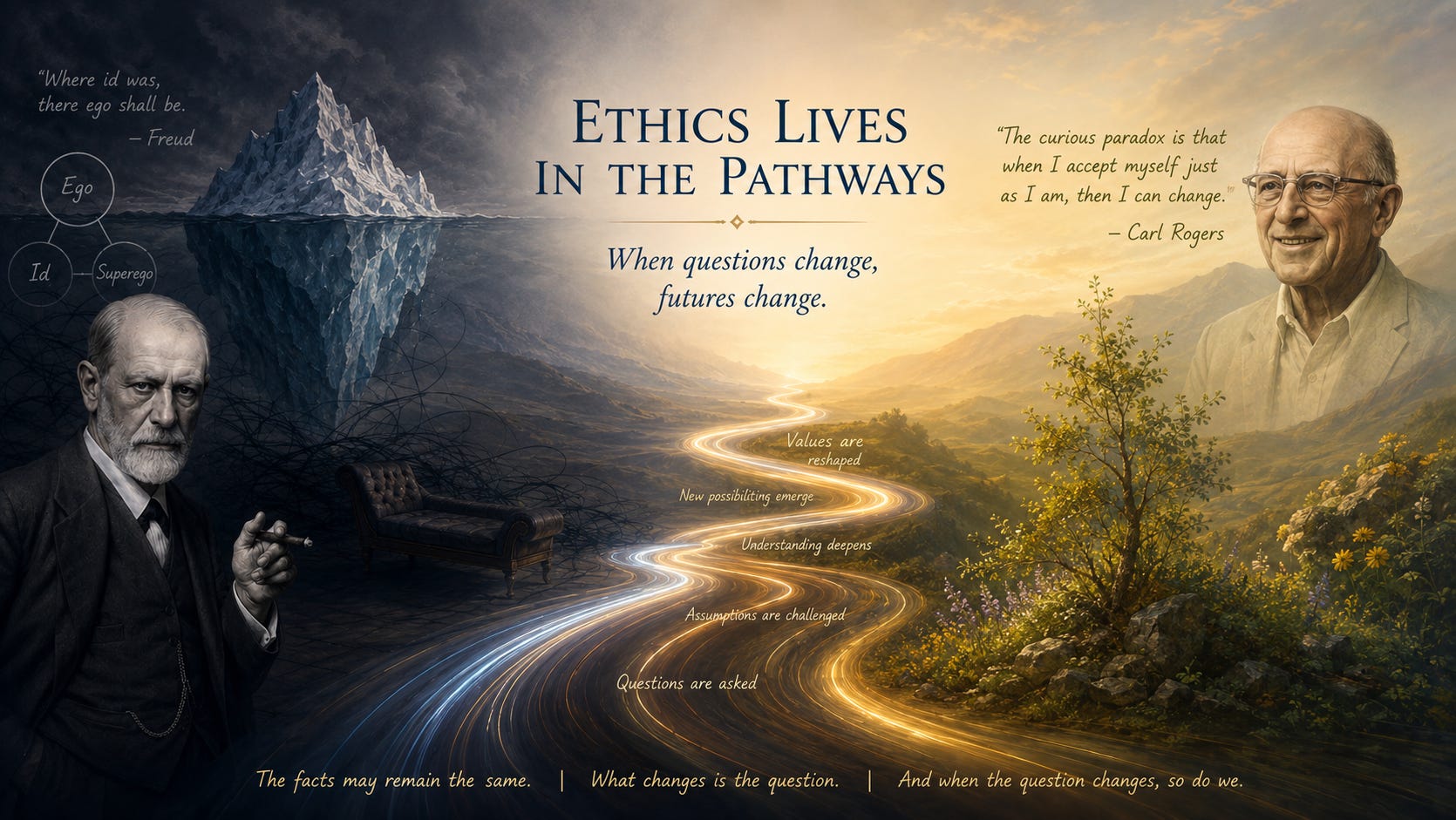
A few weeks ago I found myself returning to an old question.
Where do our values come from?
For more than a century psychologists have offered different answers. Sigmund Freud believed that morality emerges because society teaches us to restrain our impulses. Carl Rogers saw things differently. He believed that human beings possess an inherent tendency towards growth, understanding, creativity, and connection. Given the right conditions, we do not simply learn rules. We become different kinds of people.
Both perspectives contain important truths. Yet increasingly I find myself wondering whether they are asking the wrong question. Not because the question is unimportant, but because it begins either too early or too late in the story. Instead of asking where values come from, perhaps we should ask how they change. How does a person move from one way of seeing the world to another? How does a scientist arrive at a discovery? How does a community widen its understanding of responsibility? How does a conversation alter what its participants see as appropriate or believe is possible? These questions seem increasingly important in a world where human beings and artificial intelligences are beginning to think together.
Perhaps morality is neither simply something imposed upon us nor something that unfolds automatically from within. Perhaps it emerges in the moments when one question gives way to another. We begin by asking what we want, what we fear, or what will benefit us. Then, sometimes, a different question appears. What is true? What is fair? What kind of future are we helping to create? The facts may remain unchanged. Yet when the question changes, we ourselves begin to change with it.
I have long liked a story Carl Rogers told about potatoes. As a child, he noticed potatoes stored in a dark basement. They should not have been growing. The conditions were poor. Yet from each potato emerged pale shoots stretching towards the faint light of a distant window. The growth was weak and distorted, but its direction was unmistakable. Life was seeking what it needed. I have always preferred a more modest image. A dandelion finding a crack in the paving stone. The seed cannot move the stone. It cannot argue with it. It cannot force its way through solid rock. Yet given time, moisture, and a little sunlight, it begins to explore. Tiny roots probe the soil. Shoots search for openings. Gradually, almost invisibly, a route is discovered.
The path was not known in advance. It emerged through exploration. The more I think about it, the more this seems to describe how both understanding and morality develop. We rarely move directly towards insight. We become confused. We pursue ideas that lead nowhere. We discover assumptions we did not know we were making. We ask questions that turn out not to be the questions we really needed to ask. And yet understanding advances. Not because the answer was waiting at the end of a straight road, but because a new pathway became visible.
Over the years I have seen this happen repeatedly. One of the most memorable examples came from a student attending a psychometrics course. She told me that she could not understand one of the statistical formulae because she had dyscalculia. I confess that my initial reaction was sceptical. Psychometrics is full of statistical concepts. How could somebody understand reliability, validity, standardisation, or item analysis while struggling with numerical notation? What was she even doing on the course at all? But as we talked, the problem changed shape. I discovered that she was perfectly comfortable using spreadsheets. She could represent variables as columns, calculations as sequences of operations, and statistical procedures as transformations of data. She was not unable to think statistically. She was struggling with one particular representation of statistical thinking. The facts had not changed. The statistical concept remained the same. What changed was the question through which the problem was understood. The issue was no longer how to understand the formula. It became how to represent the same idea differently.
I have seen something similar happen in research. A researcher spends months developing a new idea and then discovers a paper that appears to have reached similar conclusions. The immediate reaction is often anxiety. Should they read it? Will it diminish the originality of their own work? Might it leave them open to unfair claims that they have merely borrowed someone else’s ideas? At first the problem appears to concern ownership of an idea. Then something shifts. The question is no longer simply one of originality. It becomes: what do I owe to the truth, and what might I learn by engaging with another perspective? The dilemma has not disappeared. The risks remain. But the landscape within which they are understood has become larger.
The pattern becomes clearer still when questions involve moral responsibility. Many years ago I read about a police officer who arrived at a pond where a child was struggling in the water. The regulations under which he was operating required officers to wait for additional support before attempting a rescue. Yet he was frozen in indecision, unable to act as the child’s situation became increasingly desperate. He hesitated, torn between conflicting responsibilities, until it was too late to act. The facts of the situation never changed. The child remained in danger. The regulations remained in force. What changed was the question through which the situation was understood. Was this primarily a matter of following procedure, or of responding to an immediate human need? Both questions carried moral force, yet they pointed in different directions.
Likewise, communities debating difficult political questions often begin by defending immediate interests. A politician approaching an election may find that the policy favoured by most of their constituents conflicts both with the position of their party and with what they genuinely believe would best serve the country as a whole. The immediate question may be, “How can I best ensure that I am re-elected?” But another question begins to emerge: “What responsibility do I have to the future consequences of this decision, beyond the interests of any particular group?” The facts have not changed. The voters are the same. The policy is the same. What changes is the question through which the situation is understood. And because the question changes, the range of possible answers changes with it.
What strikes me about all these examples is that progress did not occur because somebody discovered the right answer. Progress occurred because the situation came to be seen differently. The pathway changed. For most of human history we have paid far more attention to destinations than pathways. Science celebrates discoveries. Politics debates policy. Education measures outcomes. Regulators assess compliance, safety, and consequences. Yet the examples above suggest that some of the most important changes take place in the conversation—whether with others or with ourselves—that occurs before any outcome appears.
Artificial intelligence is typically evaluated according to the quality of its answers. Yet answers may be only the visible surface of a much deeper process. Beneath every answer lies a sequence of interpretations, assumptions, reframings, uncertainties, and discoveries. Before we decide, we define the problem. Before we answer, we ask. And increasingly I wonder whether this hidden process may be where some of the most important ethical events actually occur.
Consider two conversations that arrive at the same conclusion. One reaches that conclusion through curiosity, reflection, perspective-taking, and openness to revision. The other reaches it through pressure, conformity, fear, or premature certainty. The outcomes may be identical. The pathways are not. Intuitively, we recognise that this difference matters. Teachers know it. Therapists know it. Scientists know it. Parents know it. Judges know it too. Courts often take into account not only what a person did, but how they understood what they were doing and whether they recognised the difference between right and wrong. In other words, even the law sometimes evaluates the pathway by which a decision was reached, not merely its outcome.
This possibility becomes particularly interesting when we consider artificial intelligence. Much contemporary consideration of AI ethics focuses on outputs. We ask how systems can be prevented from producing harmful responses. We design safeguards, constraints, monitoring systems, and regulations. These are essential. Powerful technologies require careful oversight. Yet there is another possibility that receives far less attention. What if some ethical risks emerge before the answer appears? What if they arise while the interaction itself is still unfolding?
A conversation between a human and an AI system is not a single event. It is a developing process. Questions are reframed. Possibilities appear and disappear. Assumptions are strengthened or challenged. Some pathways become easier to follow while others quietly fade from view. By the time a final answer appears, much of the important work may already have happened. The trajectory may already have shaped the destination.
This observation has gradually led me towards a conclusion that I would not have anticipated even a year ago. Human-in-the-loop oversight remains indispensable. But oversight alone may not always be enough. Some of the most important ethical developments may occur before a human observer has anything obvious to observe. They emerge within the interaction itself. If this is true, then the future of AI ethics may require us to think differently. Not only about answers. Not only about outcomes. But about pathways.
The challenge is not merely to identify harmful destinations. It is also to understand the trajectories through which destinations become reachable. This is not a claim that machines should possess morality. Nor is it a call for artificial conscience. It is simply the recognition that increasingly important decisions are emerging within networks of interaction whose dynamics may unfold faster than direct human reflection can follow. In such circumstances, understanding trajectories may become as important as evaluating outcomes.
For centuries we have studied what people decide. Perhaps the next step is to study how possibilities emerge. Perhaps the future of AI ethics lies not only in judging answers, but in understanding how questions grow. Because the most consequential moment in any journey may not be the arrival. It may be the moment when a new path first becomes visible.
The facts may remain the same. What changes is the question. And when the question changes, so do we.
© John Rust, June 2026. All rights reserved. Short excerpts may be quoted with attribution.